

#115
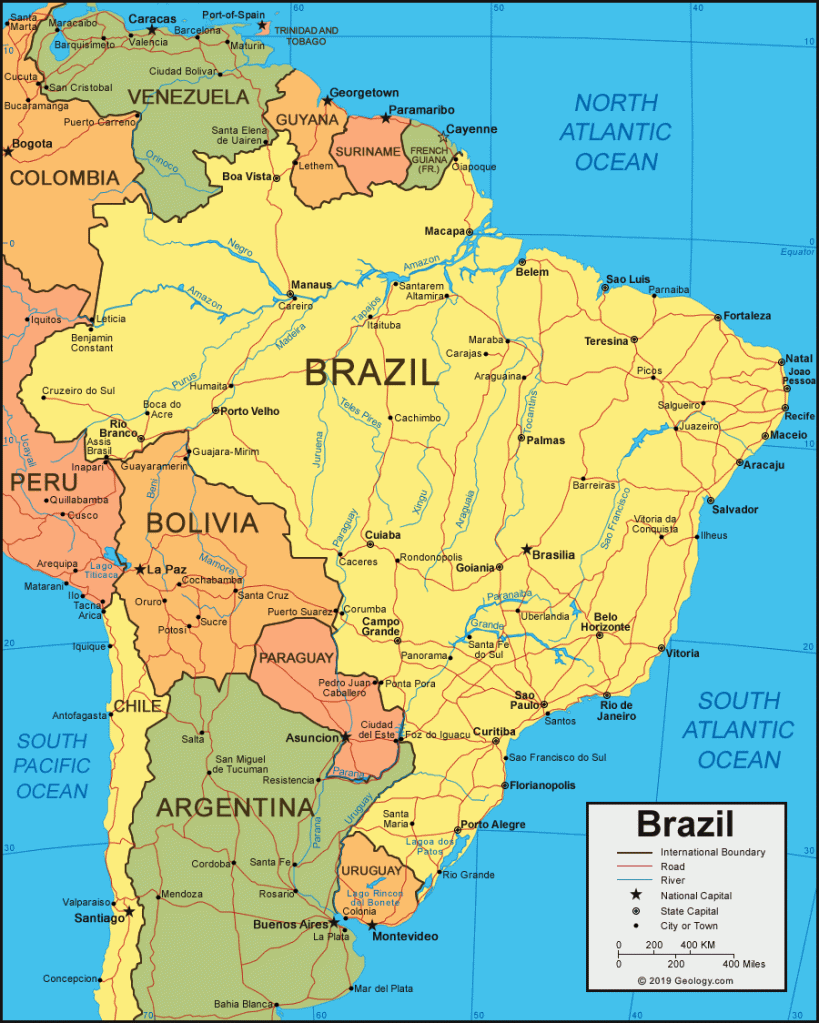
This post has some personal connection.
My paternal cousin, a Brazilian citizen and a Physics Professor at Natal-Brazil, is visiting India to spend time with us. This visit marks his return after 35 years, (1988 he attempted a year in an Indian college,coming from Brazil, proceeded to Oxford) He will undoubtedly notice significant changes in India. It reminded me of EHS implementation in Brazil. Hence this post.
During my time at Honeywell and Monsanto, I had the opportunity to interact with Brazilian EHS colleagues, which provided me with valuable insights. This post aims to share some background information on EHS in Brazil, but I must mention that I can’t guarantee complete authenticity for the information. It’s shared for general awareness.
Brazil
Population: 215 million (2023)
Land area: 8.5 million square kilometers (3.3 million square miles)
Governance: Federal republic with a presidential system. Current Incumbent: Luiz Inácio Lula da Silva. (Lula) A Union Leader with an Amputed finger.

Brazil is the fifth most populous country in the world and the largest country in South America.
It is a major agricultural powerhouse and a net exporter of food.
Brazil is also a major producer of minerals, including iron ore, bauxite, and manganese.
The country has a rich culture and history, and is home to some of the world’s most iconic landmarks, such as the Amazon rainforest and Christ the Redeemer statue.
Brazil is a popular tourist destination, known for its beautiful beaches, vibrant cities, and lively festivals. Brazilian women are known for their vibrant culture and passion for life. They play an important role in the country’s music, dance, and fashion industries.

EHS Implementation in Brazil, (What works well, What Doesn’t)
When it comes to Environment, Health, and Safety (EHS) implementation in Brazil, it’s essential to consider the unique aspects of the country’s regulations, culture, and business environment. Here’s an overview of what works well and the issues in EHS implementation in Brazil:
What Works Well:
- Regulations: Brazil has a robust regulatory framework for EHS, covering various aspects such as environmental protection, occupational health, and safety standards. These regulations are designed to ensure that companies comply with stringent EHS requirements.
- Awareness: There is an increasing awareness of EHS issues in Brazil, driven by concerns about environmental sustainability, public health, and corporate social responsibility. Many companies are taking EHS seriously and incorporating it into their business strategies.
- Certification Programs: Organizations can obtain certifications like ISO 14001 (Environmental Management Systems) and OHSAS 18001/ISO 45001 (Occupational Health and Safety Management Systems) to demonstrate their commitment to EHS standards. These certifications are recognized globally and can enhance a company’s reputation.
- Consulting Services: EHS consulting services are widely available in Brazil, providing expertise to organizations that want to enhance their EHS performance. Your experience as an EHS consultant would be valuable in this context.
Challenges and Issues:
- Enforcement: While regulations are in place, enforcement can be inconsistent in Brazil. This can lead to non-compliance by some companies, putting the environment and workers at risk.
- Bureaucracy: Dealing with bureaucratic processes and permits can be time-consuming and challenging, which may hinder efficient EHS implementation.
- Cultural Factors: The culture of Brazil, with its emphasis on interpersonal relationships and hierarchy, can sometimes impact EHS practices. Breaking through cultural barriers to promote safety and environmental responsibility can be a challenge.
- Environmental Concerns: Brazil has faced significant environmental challenges, including deforestation in the Amazon rainforest and pollution of water bodies. Addressing these issues requires a concerted effort from both the government and businesses.
- Infrastructure: In some regions, the lack of proper infrastructure and resources can hinder EHS initiatives, particularly in remote areas where EHS standards might be less strictly enforced.
In conclusion, Brazil has made strides in EHS implementation, but challenges persist, particularly in enforcement and bureaucratic processes. As an EHS consultant, you would likely find opportunities to contribute your expertise to companies looking to improve their EHS performance in Brazil. It’s crucial to be aware of the unique cultural and regulatory context of the country when working on EHS projects there.
EHS Regulations in Brazil:
In Brazil, Environment, Health, and Safety (EHS) regulations are governed by a combination of federal, state, and municipal laws and agencies. Here are key EHS regulations in Brazil, categorized into safety, environment, and health:
Safety:
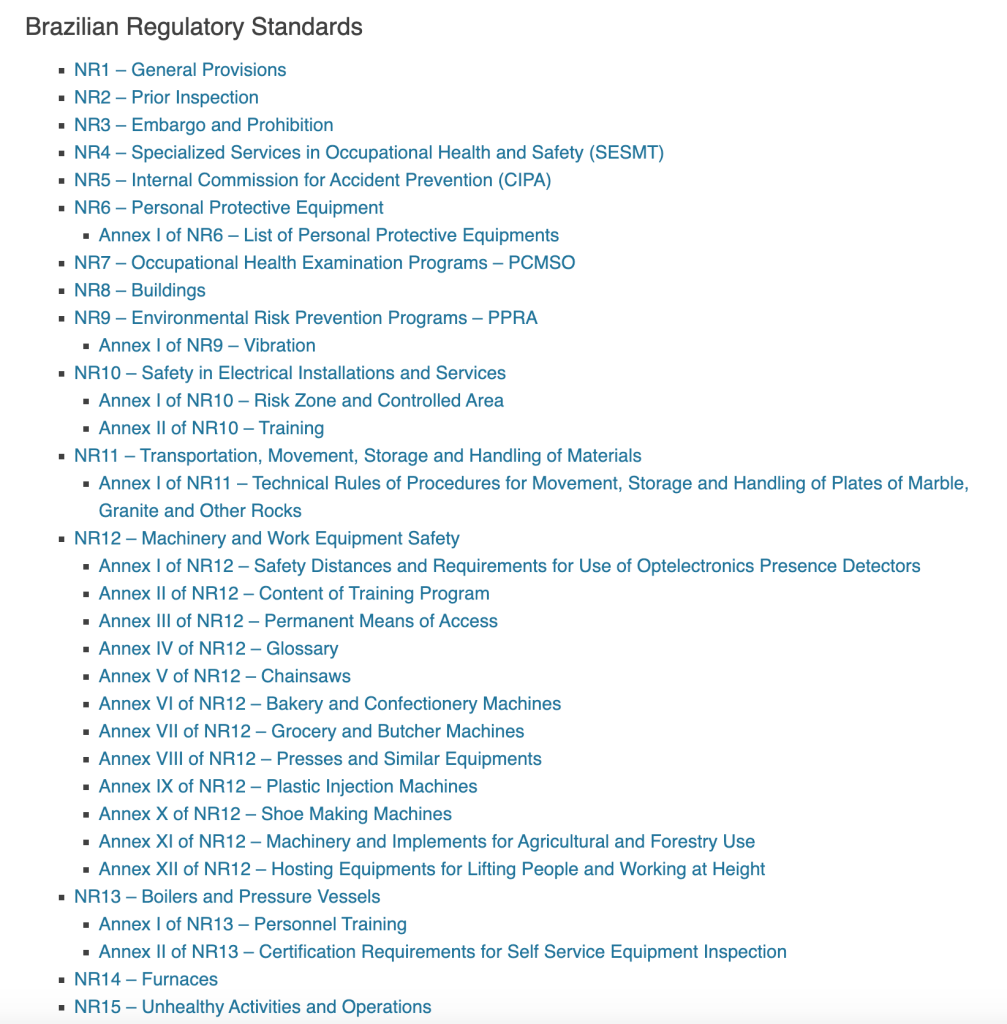
- NR 6 – Personal Protective Equipment (PPE): This regulation outlines requirements for the use of personal protective equipment in the workplace, ensuring the safety of workers.
- NR 12 – Machinery and Equipment Safety: NR 12 establishes safety standards for machinery and equipment to prevent accidents and protect workers.
- NR-15, specifically focuses on activities and operations that involve exposure to physical agents, such as noise, heat, and cold, which can affect the health and well-being of workers. (Unhealthy activities and operations)
- NR 20 – Flammable and Combustible Liquids: NR 20 regulates the storage, handling, and transportation of flammable and combustible liquids, with a focus on fire safety. (I could not get English Translation)
Environment:
- Environmental Licensing: Brazil has a complex system of environmental licensing, which varies by state and municipality. It involves evaluating and permitting activities that may impact the environment.
- Brazilian Forest Code: This law establishes rules for the protection of forests and preservation of natural resources, aiming to combat deforestation and promote sustainable land use.
- CONAMA Resolutions: The National Environment Council (CONAMA) issues resolutions addressing various environmental aspects, including water quality, waste management, and protected areas.
Health:
- NR 7 – Occupational Health Examinations: NR 7 sets requirements for occupational health examinations to monitor and ensure the well-being of workers.
- NR 9 – Risk Assessment and Control: NR 9 focuses on risk assessment and control measures in the workplace to prevent occupational diseases and accidents.
- NR 32 – Healthcare Facilities: NR 32 establishes guidelines for safety and health in healthcare facilities, considering the specific risks in the healthcare sector.
The regulatory mechanism in Brazil involves a combination of federal agencies, state-level environmental agencies, and municipal authorities. Some key entities involved in the enforcement of EHS regulations include:
- Ministry of Labor and Employment: This federal ministry is responsible for issuing and enforcing the NRs (Normas Regulamentadoras) related to occupational safety and health.
- Brazilian Institute of Environment and Renewable Natural Resources (IBAMA): IBAMA is the federal agency responsible for environmental management and enforcement of federal environmental laws.
- State Environmental Agencies: Each Brazilian state has its own environmental agency responsible for implementing and enforcing state-level environmental regulations.
- Local Municipal Authorities: Municipalities have a role in enforcing EHS regulations at the local level, and they may have their own regulations in addition to federal and state laws.
The skills and competencies of safety professionals in Brazil are similar to those in many other countries, with a focus on ensuring workplace safety and compliance with relevant regulations. Environmental management in organizations in Brazil is also driven by the need to comply with environmental laws and promote sustainability. Here are some key aspects of safety professionals’ skills and environmental management in Brazilian organizations:
Skills and Competencies of Safety Professionals in Brazil:
- Legal and Regulatory Knowledge: Safety professionals in Brazil must have a deep understanding of the country’s labor laws, specifically the Normas Regulamentadoras (NRs), which are the occupational safety and health regulations. Familiarity with these regulations and their application is essential.
- Risk Assessment: Safety professionals should be skilled in conducting risk assessments to identify and mitigate workplace hazards. This includes evaluating the physical, chemical, biological, and ergonomic risks that workers may face.
- Safety Training: They should be adept at developing and delivering safety training programs for employees to ensure that they are aware of safety procedures and best practices.
- Incident Investigation: Competence in investigating workplace incidents and accidents to determine root causes and develop preventive measures is crucial. This helps in improving safety and preventing future incidents.
- Emergency Response Planning: Safety professionals should be capable of developing and implementing emergency response plans to address various workplace emergencies, such as fires, chemical spills, and natural disasters.
- Communication and Training: Effective communication and the ability to train employees at all levels are essential for disseminating safety information and creating a safety-conscious culture in organizations.
- Ergonomics: Given the importance of ergonomics in preventing workplace injuries, safety professionals should have knowledge of ergonomics principles and how to apply them in the workplace.
- Health and Industrial Hygiene: Understanding health hazards, industrial hygiene, and occupational health is critical for managing and protecting the health of employees.
Environmental Management in Organizations in Brazil:
- Compliance with Environmental Laws: Environmental management in Brazilian organizations is primarily driven by the need to comply with a wide range of environmental laws and regulations, including those related to air and water quality, waste management, and protected areas.
- Environmental Impact Assessments: Many organizations are required to conduct environmental impact assessments (EIA) and environmental management plans (PMA) for their operations to identify and mitigate potential environmental impacts.
- Sustainability Initiatives: Brazilian organizations increasingly recognize the importance of sustainability. Environmental management often includes sustainability programs focused on reducing resource consumption, waste generation, and greenhouse gas emissions.
- Waste Management: Proper waste disposal and recycling are significant aspects of environmental management. Organizations must manage their waste streams in accordance with local regulations.
- Water and Energy Efficiency: Improving water and energy efficiency is a common goal in environmental management to reduce costs and environmental impacts.
- Certification Programs: Some organizations seek certifications like ISO 14001, which is an international standard for environmental management systems. Achieving this certification demonstrates a commitment to effective environmental management.
- Environmental Reporting: Many organizations are required to submit environmental reports to regulatory agencies, detailing their environmental performance and compliance with regulations.
Risk Based Approach to Operations, Brazil a Pioneer:
The application of a risk-based approach to safety in Brazil has matured over the years and is an integral part of the country’s safety regulatory framework. Brazil’s regulatory system for occupational safety and health (OSH) places a strong emphasis on risk assessment and management. Here are key points about the maturity of the risk-based approach to safety in Brazil:
- NR 1 and NR 1.7: Brazil’s Normas Regulamentadoras (NRs), which are the occupational safety and health regulations, have specific provisions related to risk assessment. NR 1 – General Provisions, and NR 1.7, in particular, emphasize the importance of a risk-based approach. They require companies to conduct risk assessments and develop Risk Assessment Programs (Programa de Prevenção de Riscos Ambientais – PPRA) to identify, evaluate, and mitigate workplace hazards.
- NR 12: NR 12, which deals with machinery and equipment safety, incorporates a risk-based approach. It requires companies to assess and manage the risks associated with machinery and equipment, aiming to prevent accidents and injuries.
- Risk Management Systems: Many Brazilian companies have adopted risk management systems, including the use of tools like Hazard and Operability Studies (HAZOP) and Failure Modes and Effects Analysis (FMEA), to systematically assess and manage risks. These systems are particularly common in industries with high safety concerns, such as oil and gas, petrochemicals, and manufacturing.
- ISO 45001: The adoption of ISO 45001, the international standard for occupational health and safety management systems, is growing in Brazil. This standard incorporates a risk-based approach to OSH management, emphasizing hazard identification, risk assessment, and control measures.
- Consulting and Training: EHS consulting services in Brazil often focus on risk assessment and management. Safety professionals and consultants in the country are well-versed in risk analysis methodologies and support organizations in implementing risk-based safety programs.
- Government Support: Brazilian government agencies, such as the Ministry of Labor and Employment, provide guidance and support for companies to implement risk-based safety programs. They promote the development of preventive measures based on identified risks.
In conclusion, Brazil’s safety regulatory framework places a strong emphasis on a risk-based approach to safety, and it has matured significantly in this regard. Companies operating in Brazil are encouraged and often required to conduct thorough risk assessments and implement measures to mitigate identified risks to protect the safety and health of their workers.
Path for Safety and Environmental Professional to a career:-
In Brazil, safety professionals and environmental professionals typically follow specific educational and certification pathways to qualify for their respective roles. Here’s an overview of the qualifications and mandatory requirements for safety and environmental professionals in the country:
Safety Professionals:
- Educational Qualifications: Safety professionals typically start by earning a bachelor’s degree in fields related to occupational safety and health, such as Safety Engineering, Environmental Engineering, or Occupational Safety. These programs provide a foundation in safety principles, regulations, and risk assessment.
- Certifications: Certification is often a key requirement to work as a safety professional in Brazil. One of the most recognized certifications is the “Técnico em Segurança do Trabalho” (Occupational Safety Technician) or “Engenheiro de Segurança do Trabalho” (Occupational Safety Engineer). These certifications are awarded by specific government bodies after passing required exams.
- Experience: In addition to formal education and certification, practical experience is important. Many employers seek safety professionals with a minimum number of years of experience in the field.
- Continuing Education: Safety professionals are expected to stay up-to-date with changing regulations and best practices. Continuing education and professional development are important to maintain qualifications and certifications.
Environmental Professionals:
- Educational Qualifications: Environmental professionals often hold bachelor’s or master’s degrees in fields such as Environmental Engineering, Environmental Science, or a related discipline. These programs provide knowledge about environmental laws, regulations, and management.
- Certifications: While there isn’t a specific “environmental professional” certification as there is for safety professionals, individuals can obtain certifications in specific areas, such as environmental management systems (e.g., ISO 14001) or environmental impact assessment.
- Experience: Similar to safety professionals, environmental professionals often need practical experience to qualify for more senior roles. Some entry-level positions may require less experience, but progression typically involves accumulating relevant work experience.
- Specializations: Environmental professionals may choose to specialize in areas like air quality, water quality, waste management, or environmental impact assessment. Specialized knowledge can be valuable in specific roles.
- Continuing Education: Staying current with environmental regulations and practices is crucial. Professionals often attend workshops, seminars, and conferences to enhance their knowledge and skills.
The Achilles Heel- Remediation and Labour laws in Brazil:
Remediation in Brazil can indeed be a significant challenge, and closing a financially troubled or “sick” unit can also present complexities. Here’s a brief overview of each:
Remediation in Brazil: Remediation, particularly in the context of environmental cleanup and pollution control, can be a significant challenge in Brazil due to several factors:
- Stringent Environmental Regulations: Brazil has strict environmental regulations, which means that companies must meet high standards for remediation, especially in the case of soil and water contamination.
- Enforcement: Regulatory authorities in Brazil can be vigilant in enforcing environmental laws, making it essential for companies to comply with remediation requirements.
- Cost: The cost of remediation, especially for larger or more complex sites, can be substantial. Companies may face financial challenges in funding these efforts.
- Technical Expertise: Effective remediation often requires specialized technical expertise, and finding qualified professionals can be a challenge.
Closing a Sick Unit: Closing a financially troubled or unviable unit in Brazil can also be challenging for several reasons:
- Labor Laws: Brazil has strict labor laws that require companies to follow specific procedures and provide certain benefits when laying off employees. This can make the closure process more complex and costly.
- Legal and Financial Obligations: Companies must fulfill legal and financial obligations when closing a unit, which can include settling debts, paying severance, and addressing tax and regulatory issues.
- Social Impact: There can be social and community considerations when closing a unit, as it may result in job losses and affect local economies. This can lead to public and government scrutiny.
- Regulatory Oversight: Government authorities may closely monitor and regulate the closure of a unit to ensure compliance with laws and regulations.
In both cases, remediation and unit closures require careful planning, adherence to regulations, and effective management to navigate the legal, financial, and environmental challenges involved. Companies often seek legal and financial advisors to help them navigate these complex processes.
Finally, Compare and Contrast-Brazil vs USA on EHS maturity.
Comparing and contrasting the level of maturity and implementation of Environment, Health, and Safety (EHS) practices between the USA and Brazil reveals both similarities and differences. Here’s an overview:
Similarities:
- Regulatory Framework: Both the USA and Brazil have comprehensive EHS regulatory frameworks. The USA has OSHA (Occupational Safety and Health Administration), EPA (Environmental Protection Agency), and other federal and state agencies overseeing EHS. Brazil has its own set of federal, state, and municipal EHS agencies. Both countries have regulations aimed at protecting workers and the environment.
- EHS Management Systems: In both countries, organizations often implement EHS management systems, such as ISO 14001 for environmental management and OHSAS 18001/ISO 45001 for occupational health and safety. These systems provide a structured approach to EHS compliance.
- EHS Professionals: EHS professionals play a crucial role in both the USA and Brazil. They are responsible for ensuring compliance with regulations, conducting risk assessments, and promoting a culture of safety and sustainability within organizations.
- Corporate Responsibility: There is a growing emphasis on corporate responsibility in both countries. Companies are increasingly aware of the importance of EHS practices in maintaining their reputation and mitigating risks.
Differences:
- Enforcement and Compliance: One notable difference is the level of enforcement and compliance. In the USA, EHS regulations are rigorously enforced, and non-compliance can lead to significant penalties. In Brazil, enforcement can be more variable, with some challenges related to consistency and resources for enforcement.
- Cultural and Social Factors: The cultural context is different in both countries. Brazil’s culture may place a stronger emphasis on interpersonal relationships and hierarchy, which can influence EHS practices within organizations. In contrast, the USA may have a more individualistic and litigious culture, driving a focus on risk management and litigation avoidance.
- Economic Resources: Economic disparities between the two countries can affect the level of investment in EHS. Larger companies in the USA, particularly multinationals, may have more resources to allocate to EHS initiatives. In Brazil, some smaller or less financially robust companies may struggle to invest in EHS.
- Environmental Challenges: The environmental challenges in each country are distinct. The USA faces issues such as air and water pollution, as well as climate change concerns. In Brazil, challenges include deforestation in the Amazon and water pollution in certain regions.
- Infrastructure: The quality of infrastructure and public services, including healthcare and emergency response, can vary significantly between the two countries. This can influence the practical implementation of EHS measures, particularly in rural or remote areas.
In summary, while both the USA and Brazil have robust EHS systems and professionals, there are differences in the level of enforcement, cultural factors, economic resources, and environmental challenges. These factors influence the maturity and implementation of EHS practices in each country. It’s essential for companies operating in both regions to be aware of these differences and tailor their EHS strategies accordingly.
B Karthik
5th Nov 2023.

 Health, Environment, Safety, Sustainability (HESS)