

#199
Housekeeping:- Soon, I will be posting my 200th EHS Blog post. It has been a 7 year journey to this milestone, (with 3 years of Dormant period) hopefully many more to come?. (My personal blog of 20 years, is at #520) If you have in mind, an interesting/ challenging EHS topic you want me covered, please post in comments section or reach out to me. I shall do my best. Selected topic, the person will be rewarded with a book of their choice. I look to your response.
Introduction
As a Safety (EHS) professional about to enter my 40th year in the field, I find myself reflecting on the journey and the knowledge I’ve amassed over the decades. It struck me that despite my extensive experience, I had never written about a crucial aspect of our profession: the role of safety diplomas/ credentials in career advancement.
With a Post Graduate degree in Environmental Engineering, (1985) I joined the then-named Diploma in Industrial Safety in 1988. At the time, this diploma was a relatively new curriculum post 1984, Bhopal Gas Tragedy of 1984, and we were often sponsored by industry leaders, as the mandatory norms were set by the state governments. The course lasted a year, encompassing nine papers, projects, and a requirement of 70% attendance, giving us a 30% leeway. This foundational qualification set the stage for my career, and over the years, I’ve pursued various professional credentials in process safety, Six Sigma-Lean, ISO / HSE auditor certifications, and even a postgraduate degree in HR management to complement my Safety and Environmental expertise.
In my view, EHS is fundamentally about execution—bridging the knowing-doing gap and influencing both up and down the organizational hierarchy to achieve safety goals. Success in this field demands excellent communication, influencing, persuasion, and interactive skills. It’s about being visible where the action happens and demonstrating a high level of emotional intelligence. EHS Competence is KEY and this is where these educational credentials gives the person, a great foundation to get in to basics and work from there on.
In this blog, I will delve into the merits of two significant safety diplomas: the Advanced Diploma in Industrial Safety (ADIS) approved by the Government of India, (@ state levels through the Technical education Boards) and the NEBOSH certifications. My goal is to provide insights that can help you decide which path might best suit your career aspirations and professional development.
The contents below are based on my knowledge and I do not vouch for 100% accuracy as with any educational curriculum content.
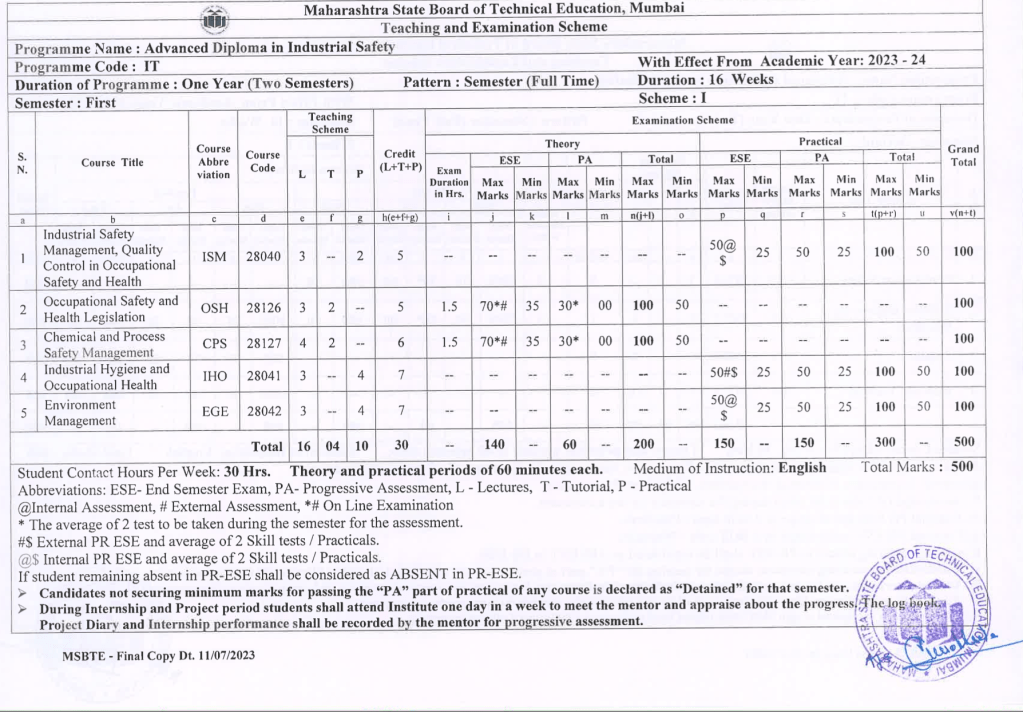
1. Advanced Diploma in Industrial Safety (ADIS)
Overview: The Advanced Diploma in Industrial Safety (ADIS) is a highly regarded qualification in India, recognized by the Ministry of Labour and Employment. It is designed to equip professionals with in-depth knowledge of industrial safety management.
Contents:
- Safety, Health, and Environment Management: Fundamentals of SHE management systems and practices.
- Industrial Safety Management: Principles and practices of safety management in industrial settings.
- Risk Management: Identifying, assessing, and controlling risks in the workplace.
- Occupational Health: Understanding occupational health hazards and implementing control measures.
- Safety Legislation: In-depth knowledge of Indian safety laws and regulations.
- Fire Safety: Principles of fire safety management and emergency response.
- Environmental Management: Environmental protection measures and sustainable practices.
- Safety Engineering: Engineering controls and technological interventions for safety. (Electrical, Chemical, Construction Safety etc.)
Advantages:
- Government Recognition: Being a government-approved course, ADIS holds significant credibility in the Indian job market.
- Comprehensive Curriculum: The course covers a wide range of topics relevant to industrial safety.
- Career Opportunities: Preferred by Indian employers, especially in the manufacturing and industrial sectors.
- Cost-Effective: Generally more affordable compared to international certifications.
- Local Relevance: The curriculum is tailored to Indian laws, regulations, and industry practices.
Timeline: The ADIS typically takes about 2 years to complete. This duration includes coursework, practical training, and examinations. Professionals can often balance this with their job commitments, making it a feasible option for those already working in the field.
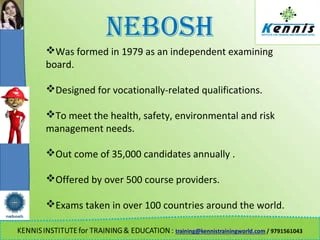
2. NEBOSH Certifications

Overview: The National Examination Board in Occupational Safety and Health (NEBOSH) offers globally recognized certifications that cater to various levels of EHS professionals. The two main levels are the NEBOSH International General Certificate (IGC) and the NEBOSH International Diploma. Ofcourse, there is a UK specific course too. The Course has now branced out to cover many EHS disciplines, check out for your area of interest.
Contents:
- NEBOSH International General Certificate (IGC):
- Management of Health and Safety: Fundamentals of health and safety management systems.
- Controlling Workplace Hazards: Identifying and controlling physical, chemical, biological, and ergonomic hazards.
- Health and Safety Practical Application: Applying theory to practical scenarios through a workplace assessment.
- 2) NEBOSH International Diploma:
- Managing Health and Safety: Advanced principles of health and safety management.
- Hazardous Agents in the Workplace: In-depth study of chemical, physical, and biological agents.
- Workplace and Work Equipment Safety: Safety principles related to machinery and equipment.
- Health and Safety Risk Management: Comprehensive approach to risk assessment and management.
Advantages:
- Global Recognition: NEBOSH qualifications are recognized worldwide, especially in the Middle East for Indians,providing an edge in international job markets. (USA has its own CSP which is a different Gorilla!).
- Depth and Breadth: The curriculum is extensive, covering a wide array of health and safety topics.
- Higher Salary Potential: NEBOSH-certified professionals often command higher salaries due to the rigorous training and international recognition.
- Networking Opportunities: Access to a global network of EHS professionals.
- Continuous Learning: NEBOSH encourages lifelong learning and continuous professional development.
Timeline:
- NEBOSH International General Certificate (IGC): This certification typically takes about 3-6 months to complete, depending on the mode of study (full-time, part-time, or distance learning).
- NEBOSH International Diploma: The diploma is more intensive and usually takes 12-24 months to complete. This duration includes study time, assignments, and examinations. Many professionals opt to study part-time while continuing to work.
Making the Choice: Which is Right for You?
Choosing between ADIS and NEBOSH depends on your career goals, location, and industry preferences:
- If you aim to work primarily within India and prefer a course aligned with local regulations and industry practices, the ADIS is an excellent choice.
- If you seek global opportunities or work for multinational companies, NEBOSH certifications offer broader recognition and career mobility.
+++++++++++++++++++++++++++++++++++++++++++++++++++++
End Note:Please take up course duly approved and validated by Government of India approved courses. Do not fall prey to fly by night operator courses. Same is true for NEBOSH courses.
Ensuring that you enroll in reputed institutions for both the Advanced Diploma in Industrial Safety (ADIS) and NEBOSH certifications is crucial for the value and recognition of your qualifications. Here are some guidelines and an “acid test” to help you choose the right institution:
Ensuring Reputed Institutions for ADIS and NEBOSH
1. Accreditation and Recognition
- ADIS: Ensure that the institution is approved by the Directorate General, Factory Advice Service & Labour Institutes (DGFASLI) or the State Technical Education Board. This accreditation guarantees that the course meets the national standards set by the Government of India.
- NEBOSH: The institution should be an accredited NEBOSH Learning Partner. You can verify this by checking the NEBOSH website for a list of accredited providers.
2. Institution’s Reputation and History
- Look for institutions with a long history of delivering EHS education and training. Established institutions with a strong track record are more likely to offer high-quality education and support.
3. Course Curriculum and Faculty
- Review the course curriculum to ensure it is comprehensive and up-to-date with current industry standards.
- Check the qualifications and experience of the faculty. Instructors should have significant industry experience and relevant academic credentials.
4. Student Reviews and Testimonials
- Search for reviews and testimonials from past students. Positive feedback on the institution’s teaching methods, faculty, and support services is a good indicator of quality.
5. Success Rates and Industry Recognition
- Investigate the institution’s success rates in terms of student pass rates and job placements. High success rates often reflect the quality of education and training provided.
- Check if the institution has any industry partnerships or recognition from professional EHS bodies.
6. Facilities and Resources
- Ensure the institution offers adequate facilities and resources, such as libraries, laboratories, and online learning platforms, to support your education.
Acid Test for Reputed Institutions
Step 1: Verify Accreditation
- ADIS: Confirm the institution’s approval from DGFASLI or the State Technical Education Board.
- NEBOSH: Check the NEBOSH website to ensure the institution is listed as an accredited Learning Partner.
Step 2: Check Industry Partnerships
- See if the institution has collaborations with renowned industries or professional bodies, which adds credibility.
Step 3: Review Faculty Credentials
- Look into the faculty profiles to ensure they have relevant industry experience and academic qualifications.
Step 4: Analyze Success Metrics
- Review student pass rates, job placement statistics, and feedback from alumni to gauge the institution’s effectiveness.
Step 5: Seek Testimonials
- Look for detailed student testimonials and independent reviews on educational forums or social media platforms.
Step 6: Evaluate Facilities
- If possible, visit the institution or take a virtual tour to assess the quality of facilities and learning resources available.
Conclusion
Both the Advanced Diploma in Industrial Safety and NEBOSH certifications offer valuable knowledge and skills for EHS professionals. By evaluating the contents, advantages, and timelines of each, you can determine which diploma aligns best with your career aspirations and professional needs. Investing in either qualification will undoubtedly enhance your expertise, credibility, and job prospects in the dynamic field of industrial safety.
If you need any discussions, thoughts, please feel free to reach out to me.
Good luck and God bless
Karthik.
9th July 2024. 1pm.

 Health, Environment, Safety, Sustainability (HESS)