

#202
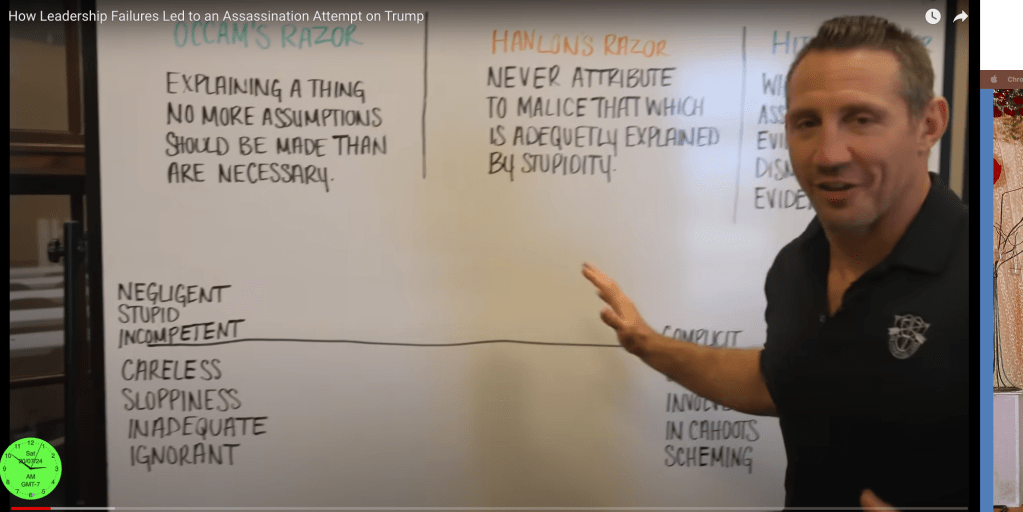
Context: This Blog comes courtesy of most Inputs from Special Forces Sniper -Tim Kennedy’s Youtube video as well as his Interview with Chris Williamson. I draw out inference based on the observations.
Background:-
The recent assassination attempt on former President Donald Trump in Butler, PA, has sparked a wave of scrutiny and analysis. As we seek to understand the root causes and systemic failures that led to this grave security breach, it is essential to approach the investigation with a clear, analytical mindset. Applying Occam’s Razor, Hanlon’s Razor, and Hitchens’s Razor provides a structured framework for dissecting the incident, focusing on the most plausible explanations, avoiding assumptions of malice, and grounding conclusions in evidence.

Occam’s Razor: Seeking the Simplest Explanation
Occam’s Razor suggests that the simplest explanation, with the fewest assumptions, is often the most accurate. In the context of the Butler incident, this means looking beyond complex or speculative theories and focusing on straightforward explanations. The operational failures observed—such as delays in communication, training deficiencies, and leadership shortcomings—point to fundamental systemic issues rather than intricate conspiracies. By applying Occam’s Razor, we streamline our investigation to address these core problems, emphasizing that systemic inefficiencies and procedural lapses are likely the primary contributors to the security breach.

Hanlon’s Razor: Avoiding Assumptions of Malice
Hanlon’s Razor advises against attributing to malice what can be explained by incompetence. While there are claims of deliberate sabotage, such as the drone survey conducted by individuals with questionable motives, it is crucial to first consider that many of the failures may be due to incompetence or inadequate systems rather than intentional wrongdoing. Operational errors, such as mismanagement of security protocols and inadequate training, are more likely to be the result of oversight and inefficiency rather than malicious intent. By applying Hanlon’s Razor, we focus on improving systems and training to address these deficiencies, rather than assuming nefarious motives.
Hitchens’s Razor: Demanding Evidence for Claims
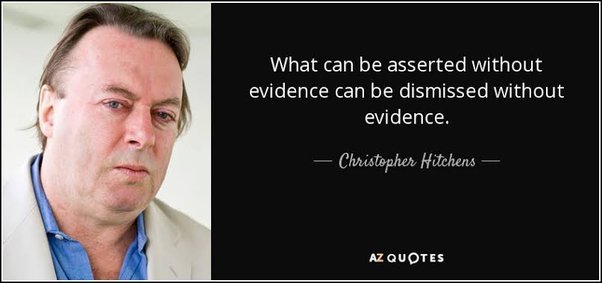
Hitchens’s Razor emphasizes the importance of requiring evidence for any claims made. In the investigation of the Trump assassination attempt, it is vital to base our conclusions on concrete evidence rather than speculation. While allegations of deliberate acts and criminal involvement have surfaced, such as the involvement of crooks in the drone survey, these claims must be substantiated with clear, credible evidence. Prioritizing evidence-based analysis ensures that our responses and reforms are grounded in factual findings, rather than conjecture.
By applying Occam’s Razor, Hanlon’s Razor, and Hitchens’s Razor to the investigation of the Butler incident, we can navigate through the complexities of the case with a focus on the most plausible explanations, avoid jumping to conclusions about malicious intent, and ensure our conclusions are supported by evidence. This analytical approach helps us to address the root causes of the security failure effectively and develop actionable solutions to restore and enhance protective measures.
Last week’s attempted assassination of former President Donald Trump in Butler, PA, has brought to light several critical failures within protective services and the broader bureaucratic system. This analysis will explore the errors, acts of omission and commission, leadership failures, and potential deliberate acts that contributed to the incident. The failures observed highlight a troubling culture of mediocrity endorsed by top-level officials and a systemic breakdown that has led to a catastrophic failure at all levels.
1. Systemic Errors and Operational Failures
Errors in Execution:
- Close Protection Team: Despite acting quickly and bravely, the close protection team ultimately served only as a human shield. Their rapid response was commendable, but it was insufficient in preventing the attack due to systemic failures in other areas.
- Counter Sniper Team: A critical error occurred when a counter sniper team member failed to maintain backward pressure at the crucial moment, compromising the team’s effectiveness and the safety of the principal. (President Trump)
- Local Support Teams: Misunderstandings of key security concepts such as “deadspace” and “line of sight” highlight gaps in training and knowledge among local support teams.
- Communications Delay: The communications network experienced a delay of at least 86 seconds in relaying the threat, which proved to be fatal in the context of the attack.
Implications: These errors reflect deeper systemic issues that need to be addressed to prevent similar failures in the future.
2. Acts of Omissions and Commissions
Acts of Omission:
- Training Deficiencies: The lack of adequate training for both operational and support teams is a significant oversight. This omission contributed to the failure to understand and act upon critical security concepts.
- Resource Allocation: Inadequate staffing and resource allocation are key omissions that undermined the effectiveness of the protective measures.
Acts of Commission:
- Mismanagement of Protocols: Active mismanagement of security protocols and failure to address known issues contributed to the operational breakdown.
- Inadequate Response Measures: The failure to implement effective response measures during critical moments further exacerbated the situation.
Implications: Addressing these acts requires a comprehensive review of protocols, training programs, and resource allocation.
3. Leadership Failures at Every Level
Bureaucratic Failures:
- Endorsement of Mediocrity: The systemic failures observed are the result of a culture of mediocrity that has been sanctioned and endorsed by upper and top-level officials in the Federal Government.
- Lack of Accountability: The failure of leadership to uphold high standards and address systemic issues has trickled down, impacting the entire organization.
Implications: Leadership must be held accountable for fostering a culture that undermines operational effectiveness and for failing to address systemic issues in a timely manner.
4. Deliberate Acts and Potential Criminal Activity
Drone Surveillance by Crooks:
- Criminal Activity: Recent findings suggest that the drone survey used to assess the site was conducted by individuals with malicious intent. This raises questions about potential premeditation and criminal planning.
- Implications: If criminal elements were involved in planning and executing the attack, it underscores the need for heightened security measures and thorough investigations into potential breaches.
Implications: Ensuring robust security measures and conducting thorough investigations are crucial to prevent similar incidents and identify any criminal involvement.
5. Restoring Excellence in Protective Services
Addressing Systemic Failures:
- Reform Training Programs: Revise and enhance training programs for all operational and support teams to ensure they understand and effectively implement critical security concepts.
- Improve Resource Allocation: Address staffing and resource deficiencies to ensure that teams are well-equipped and capable of performing their roles effectively.
- Enhance Communication Systems: Implement improvements in communication protocols to reduce delays and ensure timely and accurate information relay.
Leadership Accountability:
- Hold Leaders Accountable: Ensure that upper-level officials are held accountable for endorsing mediocrity and failing to address systemic issues.
- Foster a Culture of Excellence: Promote a culture of excellence within protective services by setting high standards and demanding performance that meets those standards.
Addressing Criminal Threats:
- Investigate Criminal Activity: Conduct thorough investigations into any potential criminal involvement and ensure that security measures are in place to prevent such breaches.
- Strengthen Security Measures: Implement enhanced security protocols to safeguard against future threats and prevent similar incidents.
+++++++++++++++++++++++++++++++++++++++++++++
Applying Occam’s Razor, Hanlon’s Razor, and Hitchens’s Razor to the Butler PA incident can provide a structured approach to understanding and addressing the systemic failures and operational issues. Here’s how each principle can be used to derive inferences:
1. Occam’s Razor: Simplifying the Analysis
Principle: “Entities should not be multiplied beyond necessity.” This principle suggests that the simplest explanation, with the fewest assumptions, is usually correct.
Application to the Butler PA Incident:
- Simplified Explanation: The simplest explanation for the failures observed may be that they are the result of systemic issues and operational shortcomings rather than complex or conspiratorial factors.
- Operational Issues: The immediate cause of the failures appears to be deficiencies in training, communication, and resource allocation, rather than elaborate or hidden agendas.
- Leadership and Training: The systemic nature of the failures points to a straightforward issue of inadequate training and leadership failures, rather than a convoluted set of errors or deliberate sabotage.
Inference: The core problems likely stem from systemic deficiencies and a culture of mediocrity rather than more complex or hidden factors.
2. Hanlon’s Razor: Avoiding Assumptions of Malice
Principle: “Never attribute to malice that which can be adequately explained by incompetence.” This principle advises us not to assume malicious intent when incompetence or error can explain the situation.
Application to the Butler PA Incident:
- Incompetence Over Malice: While there are suspicions of criminal activity (e.g., the drone survey by crooks), it’s important to first consider that many of the observed failures could be attributed to incompetence or systemic issues rather than deliberate malicious intent.
- Operational Failures: The operational errors (e.g., delay in communications, misunderstanding of security concepts) can be primarily attributed to inadequate training and systemic failings rather than intentional sabotage.
- Leadership Shortcomings: Leadership failures and the endorsement of mediocrity may be due to poor management and lack of oversight rather than intentional harm.
Inference: The failures are likely the result of incompetence and systemic issues rather than intentional malice. Focusing on addressing incompetence and improving systems should be the priority.
3. Hitchens’s Razor: Demanding Evidence for Claims
Principle: “What can be asserted without evidence can be dismissed without evidence.” This principle suggests that claims lacking evidence should not be given undue consideration.
Application to the Butler PA Incident:
- Evidence-Based Analysis: Claims of deliberate sabotage (e.g., the drone survey by crooks) should be substantiated with concrete evidence before concluding that they played a significant role in the incident.
- Focus on Evidence: The analysis should focus on evidence-supported issues like training deficiencies, communication failures, and leadership shortcomings. These are well-documented and can be addressed through specific reforms.
- Avoid Speculation: Avoid speculating about complex conspiracies or unsubstantiated claims without clear evidence. Instead, address the documented failures and work on improving systems and procedures.
Inference: Prioritize addressing evidence-supported issues such as training and communication failures. Claims of deliberate acts should be backed by concrete evidence before being used to guide responses and reforms.
B Karthik
20th July 2024 1700 Hrs.

 Health, Environment, Safety, Sustainability (HESS)