

#149
Just an hour ago, I stumbled upon a captivating article in the Financial Times (UK) titled “Office Politics – Learn to Play the Game, Else You Will be Its Victim.” It struck a chord, prompting me to reflect on my corporate journey. A mere dozen years ago, when I bid farewell to the corporate realm, navigating office politics wasn’t a focal point for career growth. However, the ever-accelerating pace of workplace transformations has me pondering if mastering the intricacies of office politics has become an essential element for climbing the career ladder. Join me on this exploration as I delve into the evolving dynamics of office politics and its newfound relevance in the pursuit of professional advancement. Here’s to unraveling the mysteries and embracing the shifts that shape our professional narratives!
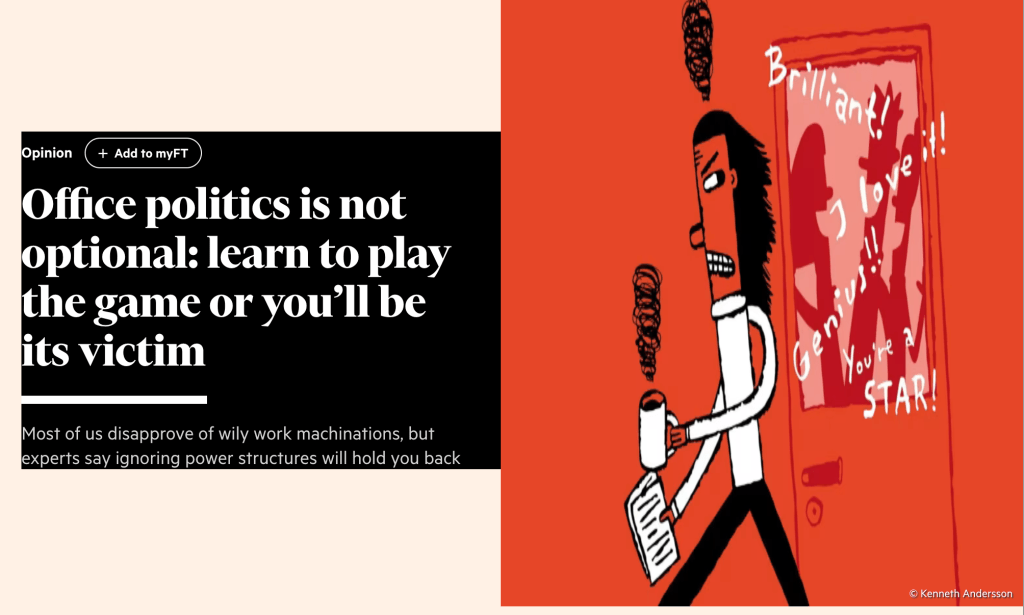
Introduction to Office Politics: Office politics refers to the dynamics and power struggles within a workplace as individuals navigate their professional relationships. It involves the use of influence, tactics, and strategies to gain advantages, visibility, or control within the organizational structure.
Elements of Office Politics:
- Power Structures: Hierarchical distribution of power and authority.
- Networking: Building alliances and relationships for professional gain.
- Decision-Making Dynamics: Influence on decision-making processes.
- Communication Channels: Strategic use of communication for impact.
- Conflict Resolution: Handling conflicts to one’s advantage.
- Perception Management: Shaping how others perceive your actions and intentions.
These elements shape the complex landscape of office politics.
The prevalence of office politics in recent times (in the last 15 years) can be attributed to several factors:
- Increased Competition: Globalization has intensified competition, making individuals more driven to secure career advantages, leading to strategic maneuvering.
- Flatter Organizational Structures: With organizations adopting flatter hierarchies, the lines of authority and decision-making become less clear, creating more room for political dynamics.
- Emphasis on Soft Skills: Soft skills, including networking and influencing, are now recognized as crucial for career success, prompting individuals to engage in office politics to enhance these skills.
- Digital Age Challenges: The rise of virtual communication and remote work has altered traditional office dynamics, requiring individuals to navigate politics in new ways.
- Complex Decision-Making: Complex business environments demand intricate decision-making processes, increasing the stakes and motivations for engaging in office politics.
- Diversity and Inclusion: Efforts to promote diversity and inclusion have changed the workplace dynamic, introducing new dimensions to power dynamics and relationships.
These shifts contribute to the evolving nature of office politics, making it more prevalent than it might have been in the past.
The best book that lays out Power linked to Office Politics is “POWER” why Some people have it and others don’t by Stanford Professor Jeffery Pfeffer. Pfeffer’s book highlights key aspect to work the power.

Jeffrey Pfeffer’s Power, connect to office politics by providing strategic guidelines for navigating the complex dynamics within the workplace:
- “Conceal Your Intentions”: In office politics, not revealing your full intentions allows you to strategically position yourself, avoiding unnecessary conflicts and maintaining an element of surprise.
- “Always Say Less Than Necessary”: Being mindful of what you disclose helps you control the information flow, preventing others from using your words against you and ensuring you retain influence.
- “Get Others to Do the Work for You”: Delegating tasks can build alliances, creating a network of individuals who owe you favors, a powerful asset in office politics.
- “Use Selective Honesty”: Strategic honesty is key in office politics. Revealing information strategically helps shape perceptions and maintain credibility.
- “Pose as a Friend, Work as a Spy”: Building friendly relationships while staying observant aligns with understanding the social landscape, gathering valuable information discreetly.
- “Play to People’s Fantasies”: Aligning your actions with the aspirations of others can garner support and make you more influential in the political arena.
- “Be Irreplaceable”: Cultivating unique skills and knowledge positions you as indispensable, enhancing your power and influence in the workplace.

These rules provide a framework for individuals to navigate and thrive in the sometimes intricate world of office politics.
Good Aspects of Office Politics:
- Networking opportunities
- Access to valuable information
- Visibility for career advancement
- Collaboration on projects
- Skill development through challenges
Not So Good Aspects:
- Favoritism and biases
- Unhealthy competition
- Gossip and rumors
- Lack of transparency
- Stress and negative impact on well-being.
Here’s a quick list for EHS professionals navigating office politics:
Do’s:
- Build Genuine Relationships: Cultivate authentic connections within and outside the EHS department.
- Stay Informed: Be aware of organizational changes, industry trends, and key players.
- Effective Communication: Clearly articulate the importance of EHS initiatives and their impact on overall organizational goals.
- Alliance Building: Collaborate with influential individuals to garner support for EHS initiatives.
- Adaptability: Be flexible and open to adjusting strategies to align with organizational priorities.
Don’ts:
- Isolation: Avoid isolating the EHS function; integrate it into broader organizational goals.
- Ignoring Power Structures: Understand and acknowledge existing power structures; work within them strategically.
- Neglecting Communication: Failure to communicate the value of EHS initiatives may lead to reduced support.
Skill Sets for Navigating Office Politics:
- Emotional Intelligence: Understand and navigate emotions in professional relationships.
- Influence and Persuasion: Effectively advocate for EHS initiatives and gain support from key stakeholders.
- Strategic Thinking: Plan and execute EHS strategies aligned with overall organizational objectives.
- Networking: Build a network within the organization to enhance visibility and support for EHS.
- Conflict Resolution: Handle conflicts diplomatically to maintain positive relationships.
Remember, the goal is to use power as a tool to advance EHS goals in a positive and ethical manner.
Balancing Act for EHS Professionals:
Avoid Sucking Up:
- Authenticity: Be genuine in your interactions; avoid insincere flattery.
- Competence: Showcase your EHS expertise to gain respect based on skills, not just politeness.
- Professional Boundaries: Maintain professionalism; don’t compromise integrity for favor.
Effective Political Play:
- Strategic Alliances: Build relationships strategically to gain support for EHS initiatives.
- Communication Skills: Effectively convey the importance of EHS within the organizational context.
- Adaptability: Align EHS goals with broader organizational objectives to demonstrate value.
Balance involves being politically savvy without compromising professional integrity.
Closing Thoughts
Reflecting on my journey, I realize the evolution of the professional landscape. Back then, I considered myself fortunate to sidestep the intricate web of politics. Little did I know, the dynamics were transforming a dozen year later.
Today, navigating office politics isn’t just a skill; it’s a necessity. The changing global landscape demands EHS professionals to not only excel in technical proficiency but also master the art of strategic relationships.
In embracing this reality, we fortify our positions as advocates for safety and well-being. Let’s leverage this skill not for personal gain, but to propel the importance of EHS to the forefront. After all, in this new era, being politically astute is a tool to champion the causes that truly matter.
Here’s to embracing change and ensuring our voice is heard in the ever-evolving symphony of the professional world! Cheers to a future where EHS not only saves lives but also shapes organizational destinies.
Karthik
30th Jan 2024. 1500 Hrs.

 Health, Environment, Safety, Sustainability (HESS)
Great Article. Gives a flavour of Modern Day working. Politics becomes essential as breathing. All issues are well covered. The common denominator is Networking and High Emotional Intelligence. It’s one’s own ingenuity which is needed to apply these. What I liked here was Selective Honesty. Share details just about enough to get things done or get the desired output. Well articulated and presented
LikeLike
Thanks Bala. Amazing to see how things changed in 15 years…! Wonder if we would have adapted to this style? Probably not?? Yes, being resillient people that we are, may be we would have…!!
I always felt quitting corporate in 2012 was the best decision made! Never looked back at it, as was decision to move to South India in 1996..!
Thanks once again.
Regards
Karthik.
LikeLike